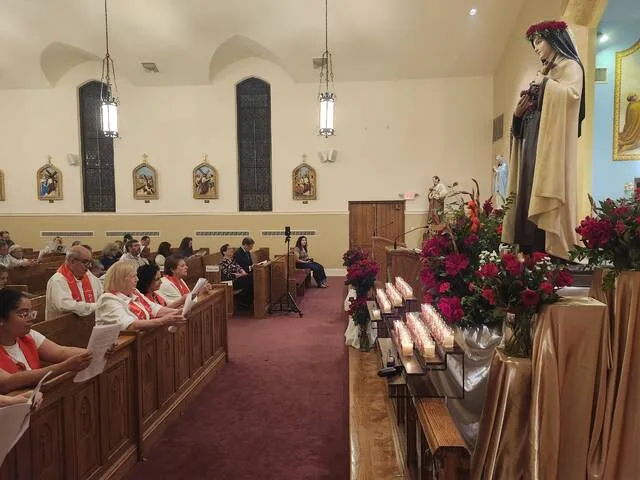
People in the front pews at St.. Anthony - St. George Maronite Church during the recent Centennial Novena to St. Therese wore red stoles that identified them as belonging to a St. Therese Sodality, a group devoted to the saint, that church pastor the Rev. Adib Salameh organized.
Mary Therese Biebel | Times Leader
St. Anthony - St. George Church devotion honors St. Therese of Lisieux

Roses adorn the statue of St. Therese during the 100th annual novena in her honor hosted by Wilkes-Barre’s Maronite Catholic community.
Mary Therese Biebel | Times Leader

A cake decorated with roses was served at the reception in the church hall that followed the 100th anniversary Novena celebration.
Mary Therese Biebel | Times Leader
As Chorbishop Peter Azar and other priests walked up the aisle to celebrate the recent 100th annual Novena to St. Therese at St. Anthony – St. George Maronite Church in Wilkes-Barre, a shower of rose petals gently floated down from the choir loft onto their procession.
Later, each of the close to 180 people who took part in the Divine Liturgy and Novena prayers received a long-stemmed red rose.
Arrangements of roses stood before a statue of the beloved St. Therese as well, and a garland of roses adorned the statue’s head.
All these physical roses reminded those in attendance about a promise from this 19th century French saint that she would “spend my heaven doing good on earth,” and they symbolized the spiritual roses, or blessings great and small, that people believe they have received through the saint’s intercession.
Speaking casually as she mingled at a reception after the Liturgy, Adrienne Perhach of Forty Fort, who admitted she feels nervous about traveling, said she believes St. Therese protected her on a recent trip, helping her to safely reach the New Jersey shore and return.
Testimony about blessings more dramatic in nature could be found in a booklet the centennial committee had compiled. The booklet contained photocopies of hand-written, heartfelt letters — one dated July 1, 1939, and addressed to the former pastor of St. George Maronite Church, the Rev. El-Mouallem. It was signed by a Mrs. Edward Novick of Wilkes-Barre, who wrote that her 4-year-old daughter “had a very bad heart condition. The doctor gave up hope so we prayed to St. Theresa to save her life, and our prayers were answered, and today she is enjoying the best of health.”
In a letter from September 1936, a Mr. and Mrs. Frank Burawski of Wilkes-Barre wrote that their little boy’s epileptic seizures had stopped after they prayed a Novena. And in a letter from 1959, a 21-year-old man named Robert, from Archbald, credited St. Theresa with helping the “nervous affliction of the head and shoulders,” which had troubled him for 10 years, to leave him.
In each of the letters, which date from 1936 to 1959, the people who wrote them spelled the saint’s name with an “A” at the end, which is a common American spelling. More recently, as the committee put together a booklet for the “Centennial Celebration of St. Thérèse’s Novena,” they spelled her name the French way.
Parishioner Malak Khoudary, an organizer of the Centennial Celebration, traveled to France earlier this year. She toured the home in Alencon where Therese lived as a child and also visited the shrine of St. Therese of the Child Jesus in Lisieux, where the saint had lived as a nun before her death in 1897 at age 24.
After Khoudary told the shrine’s rector, Monseignor Emmanuel Schwab, about the 100 years of Novenas at St. Anthony – St. George Church in Wilkes-Barre, he presented her with a letter congratulating the parish and “ask(ing) God to pour out abundant blessings upon your parish, each parishioner, and all the residents of your city.”
The rector also gave Khourday a relic of St. Therese’s parents, Louis Martin and M. Zelie Guerin, who have been canonized as saints more recently than their daughter. The relics are pieces of garments, and they have been placed in a reliquary at the local church. People who attended the Novena lined up to kiss those relics as well as a relic of St. Therese that the church has had for many years.
“This hundredth anniversary is much more than a milestone in time,” Chorbishop Peter Azar said in his remarks. “It is a celebration of a century of faith, prayer, devotion, and the countless graces that God has bestowed upon generations of parishioners through the intercession of St. Therese of Lisieux.”
In addition to the annual Novena, which runs for nine consecutive days culminating Oct. 1, St. Anthony – St. George Maronite Church hosts a perpetual Novena of prayers at 3:30 p.m. on Saturdays throughout the year, followed by the 4 p.m. Divine Liturgy. Church pastor the Rev. Adib Salameh urged people to attend that devotion on a weekly basis.